

terminal blocks
The backbone of every terminal strip – standards-compliant, modular, DIN rail mounted
Rail-mounted terminal blocks are connection components for professional control cabinet assembly. They are mounted on the 35 mm DIN rail (TS 35), can be combined into terminal strips of any length, and form the basis of every standards-compliant wiring installation in control and power circuits. Unlike choc blocks or field-wiring connectors, rail-mounted terminals are designed for DIN rail installation – with defined rated currents, rated voltages, and connection technologies per IEC 60947-7-1. At WATT24 you'll find rail-mounted terminal blocks as standard screw terminals, protective conductor terminals (PE), and two-level and three-level terminals for space-saving wiring.




€0.06 net €0.05
Immediately available, shipping in 1-2 business days


€1.80 net €1.51
Immediately available, shipping in 1-2 business days


€32.69 net €27.47
Immediately available, shipping in 1-2 business days

€3.55 net €2.98
Immediately available, shipping in 1-2 business days

€0.90 net €0.76
Immediately available, shipping in 1-2 business days

€1.18 net €0.99
Immediately available, shipping in 1-2 business days
€0.99 net €0.83
Immediately available, shipping in 1-2 business days
€1.76 net €1.48
Immediately available, shipping in 1-2 business days
€1.52 net €1.28
Immediately available, shipping in 1-2 business days

€3.65 net €3.07
Shipping in 3 day(s)

€11.04 net €9.28
Immediately available, shipping in 1-2 business days

€0.38 net €0.32
Immediately available, shipping in 1-2 business days

€0.06 net €0.05
Immediately available, shipping in 1-2 business days

€0.11 net €0.09
Immediately available, shipping in 1-2 business days

€1.55 net €1.30
Immediately available, shipping in 1-2 business days
€49.17 net €41.32
Immediately available, shipping in 1-2 business days

€0.43 net €0.36
Immediately available, shipping in 1-2 business days


€0.61 net €0.51
Immediately available, shipping in 1-2 business days

€1.33 net €1.12
Immediately available, shipping in 1-2 business days

€0.55 net €0.46
Immediately available, shipping in 1-2 business days
€0.82 net €0.69
Immediately available, shipping in 1-2 business days

€1.55 net €1.30
Immediately available, shipping in 1-2 business days

€0.36 net €0.30
Immediately available, shipping in 1-2 business days
€3.50 net €2.94
Immediately available, shipping in 1-2 business days
- Comprehensive advice & support
- over 10,000 articles in the shop
- Shipping in 24 hours
- thousands of satisfied customers


KATHRIN BRANDT
Employee Purchasing from TroisdorfGreat advice and friendly service. I was helped immediately and competently with any questions. Gladly again.

OMAR NASER
Office Manager from Frankfurt a.M.Goods are well packaged and arrive safely, which is important to me. My mail was answered immediately.

RAINER SEIDEL
Master carpenter from WiesbadenHad to replace a lamp, but the same was no longer available. Great advice, found a suitable replacement and delivered it quickly.
What is a rail-mounted terminal block?
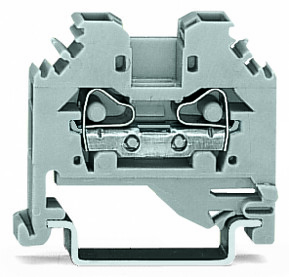
A rail-mounted terminal block is a DIN rail-mounted connection terminal for control cabinet assembly. It connects conductors electrically – in a standards-compliant, releasable manner, within defined electrical parameters (rated voltage, rated current, cross-section). The name comes from the way they are used: rail terminals are lined up into terminal strips – any number of terminals side by side on a DIN rail, closed off with end brackets and end plates.
Rail-mounted terminal blocks are not field connectors – they belong in the control cabinet. The governing standard is IEC 60947-7-1 (VDE 0611-1), which regulates rated voltage, rated current, insulation, and mechanical strength. Installation is on the 35 mm mounting rail (TS 35).
Rail-mounted terminal block types at a glance
| Type | Feature | Typical application |
|---|---|---|
| Standard rail terminal | Feed-through connection, single level | Control and power circuits of all kinds |
| Protective conductor terminal (PE) | Conductively connected to DIN rail, green-yellow | Standards-compliant PE distribution in control cabinets |
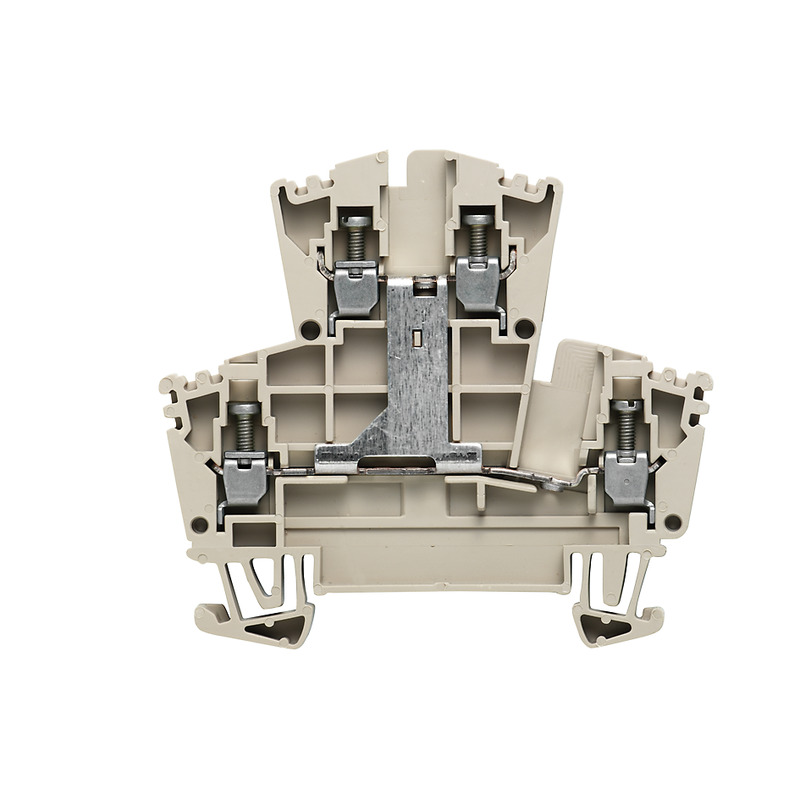
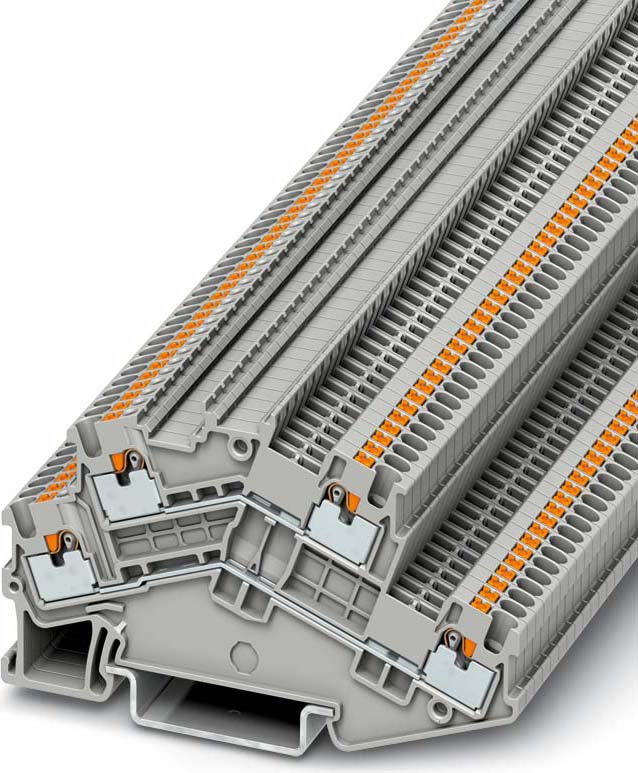
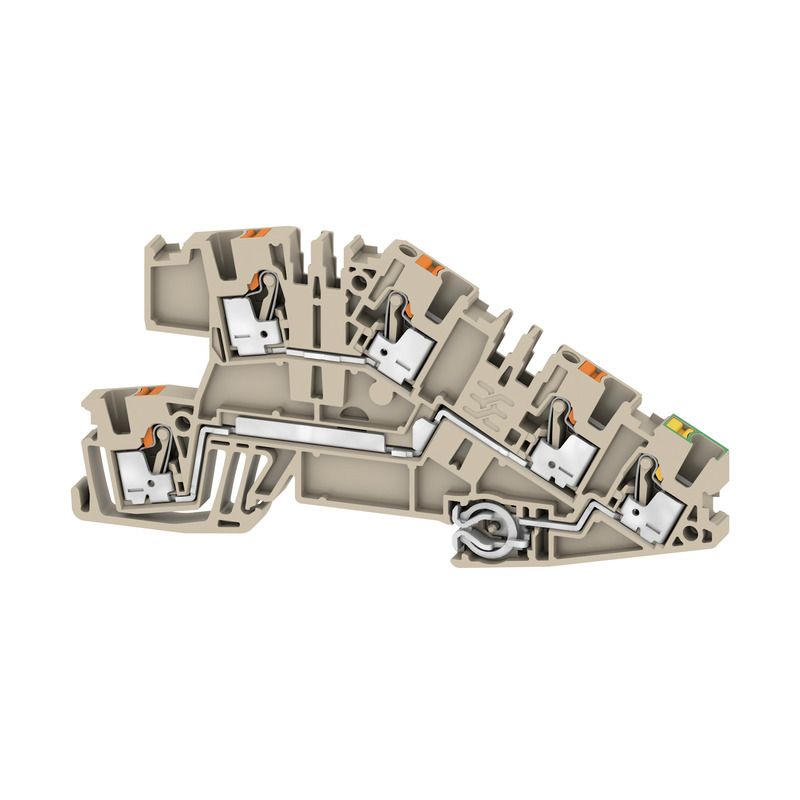
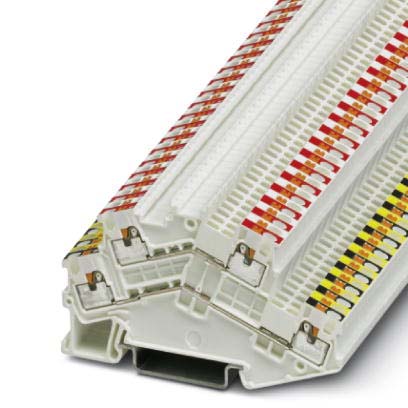
| Two-level terminal | Two galvanically isolated levels in one terminal | Space-saving wiring at high conductor density |
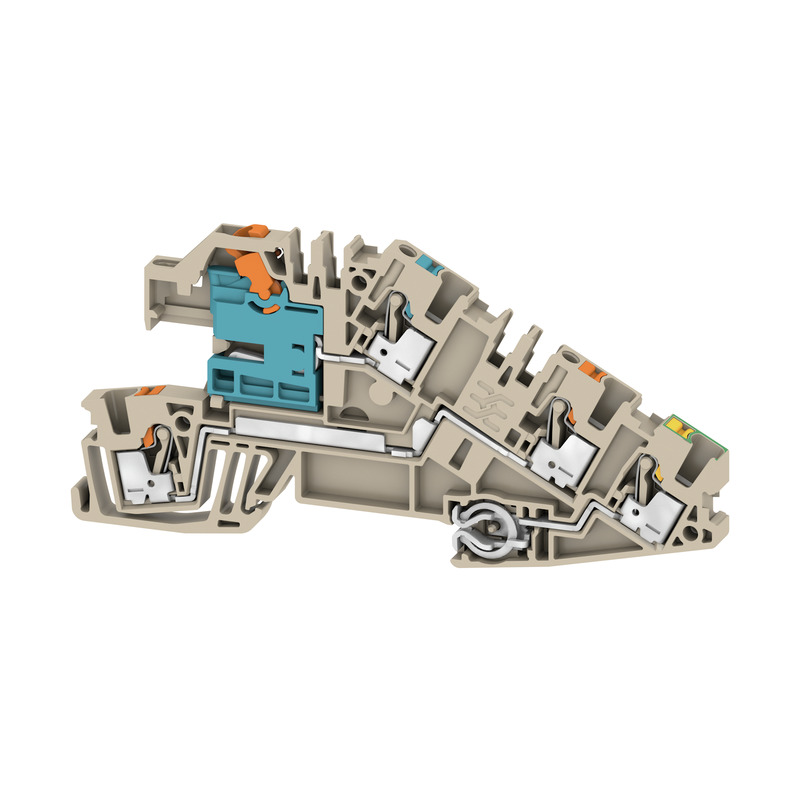
| Three-level terminal | Three galvanically isolated levels in one terminal | Maximum wiring density, complex switchgear installations |
Selecting the right rail-mounted terminal block
Three criteria determine the right choice:
- Conductor cross-section and rated current: The terminal must be rated for the cross-section and operating current of the circuit – from 0.5 mm² for control cables up to 95 mm² for power circuits
- Terminal type: Standard for feed-through connections, PE terminal for protective conductors, multi-level terminals where DIN rail space is limited
- Manufacturer system: Accessories such as bridges, marking carriers, and end plates are not cross-compatible between manufacturers – always use a single system throughout
Frequently asked questions about rail-mounted terminal blocks
Rail-mounted terminal blocks are mounted on the 35 mm DIN rail and designed for professional control cabinet assembly per IEC 60947-7-1. Feed-through connectors (e.g. WAGO 221) are compact field connectors without a DIN rail – they connect conductors directly inside junction boxes or field wiring, without any control cabinet connection.
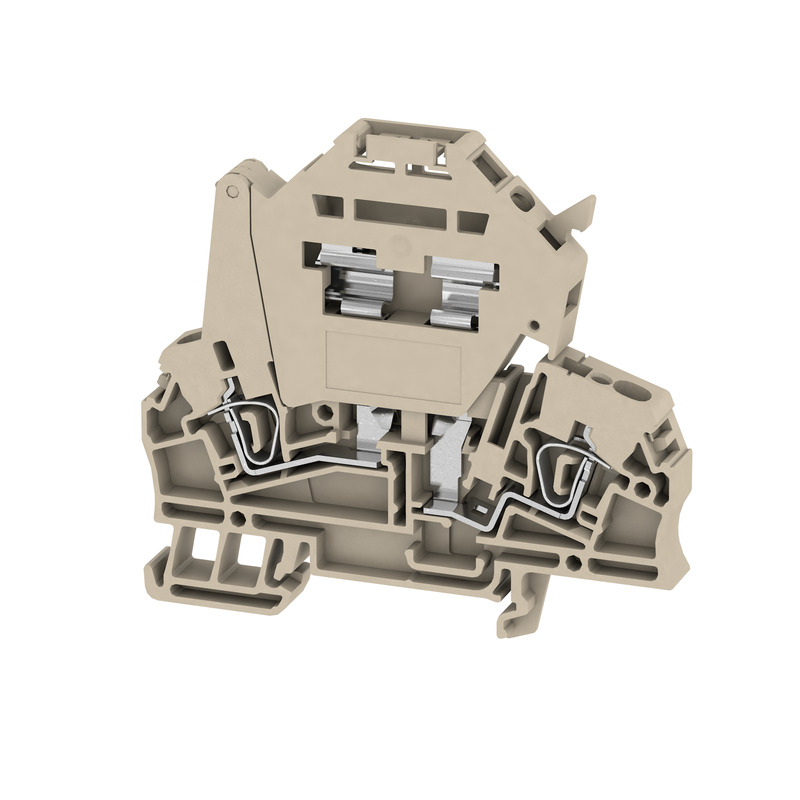
The most common types are standard rail terminals (feed-through connection), protective conductor terminals (PE), two-level terminals (two galvanically isolated levels), and three-level terminals (three levels). Disconnect terminals, fuse terminals, and measuring terminals are also available for specific applications.
Rail-mounted terminal blocks are mounted on the standard 35 mm mounting rail (DIN EN 60715, TS 35) – the universally used standard rail in control cabinet assembly.
Not recommended. While all rail terminals mount on TS 35, pitch dimensions, accessories (end brackets, bridges, marking carriers) and partition plates are manufacturer-specific. Always use the same system within a single terminal strip.
Rail-mounted terminal blocks for control cabinet use must comply with IEC 60947-7-1 (in Germany: VDE 0611-1). This standard governs rated voltage, rated current, creepage distances, insulation, and mechanical requirements.
Buy rail-mounted terminal blocks at WATT24
At WATT24 you'll find rail-mounted terminal blocks as standard screw terminals, protective conductor terminals, and two-level and three-level versions from proven manufacturers such as Phoenix Contact and WAGO – available for fast delivery at fair prices for electricians and commercial customers.